Showing posts with label Trek. Show all posts

Friday, January 24, 2014

Star Trek: The Re-Imagined Card Game

2 player "transwarp speed" preconstructed deck(s) with agreed TIME LIMIT (often 45 minutes after set-up)
Distilled from the thousands-card customizable card game (1E) by Decipher, repurposed to focus on speed of play, eased learning curve, theme, reduced confusion, nostalgia, and fun. I have made the play decks a tad bit larger for this version.

Three sentence rules summary: Players agree on time limit conditions, then deal out “Obstacle Deck”, deal out spaceline, both players select their “starting fleet,” then shuffle decks and deal 7 cards to each player. Players then alternate turns of playing 2 cards (plus free cards), taking actions (if any), trying to score points, and then ending turn to draw 2 new cards. It’s a race to have the most points by endgame (or first to 100 points).

WITH COMBINED SEED DECK (and with 1:1 customizable personnel available)
(redesigned "house rules" for time limit)
wanted: Attack Authorization, Gorn Encounter x 2, Borg Sphere x 2, Escape Pods incident, Punishment Box x2, Remodulation, Barclay Transporter Phobia, Rager

current draw (8+22+20+1= 51) + draw #2 (51) + shared seed (55) = 157

updated "house rules"
Game setup: (7 steps)
1) Each player receives his/her Draw Deck (preconstructed and equal) of 51 cards.
2) The shared Seed Deck is brought out, and separated into Missions and Obstacles (Dilemmas/ Enemy Ships/ Q cards, ignoring space/planet issues unless the word "planet" is used).
3) The players now agree to 3 articles that affect how long the game lasts:
One, how many Obstacles? And two, what time limit? And three, how many cards played/drawn each turn? Default is 3 obstacles, 2 cards played/drawn, and 1 hour (began once "starting fleet deployment" and set-up completed).
4) The missions are shuffled, and then laid out into a Spaceline ("Auto-Seeds"), all facing one direction, and all open to all players, ignoring quadrants.
5) Now, Obstacles (dilemmas/ enemy ships/ Q) are also shuffled. A number of Obstacles is agreed upon for every mission (from 1 to 4; 3 preferred; lower number speeds up the game). Obstacles are now seeded: a chosen number under each mission, random and hidden, all equal amounts (skipping Space and Nebula missions).
6) Now, each player selects (from Draw Deck) "Starting Fleet Deployment". Each Player begins with one outpost (placement their choice), one ship (their choice but usually USS Galaxy, at outpost), and 3 Federation (Blue) personnel (one gold staff icon and two silver icons) (again, their choice, and again at the outpost).
7) Note: players need to realize they will eventually have a discard pile, a played card area, and a points-modifier area, to be used if and when they are.

Gameplay:
Each player plays 2 (or agreed upon varient) regular cards during turn, then makes command decisions ("taking actions"), tries to score points, then draws 3 new cards. Alternate player repeats. Simple.
Sorta. Some cards changed how many cards are drawn or played, or "stop" parts of your fleet from taking more actions, or otherwise confuse things. Also, some cards (when played) allow "downloading" specific cards. Even further, all of your allowed end-of-turn card draws, together, may be converted, each turn, at whim, into one (and only one) "download to hand" (aka "recruiting") function of one Federation personnel card. One per turn.
Interrupts may be played at any time and do not require a card play. Tribbles play for free, but only on your turn. Tactic cards play during any ship battle, almost like an interrupt. All other cards (such as events, objectives, and incidents) use a card play on your turn, unless they specify. Personnel and Federation ships can only report/play to your outpost (again, unless they specify). Equipment cards may report to your ship(s).
"Taking actions" includes ship/personnel movement and mission attempts and attacking ship-dilemmas.
Again, thats:
1) Play 2 cards (or skip either, if you choose, or plays-for-free also, or varient)
2) Take actions, such as moving/beaming/docking, attempting missions, and a few others.
3) Announce you end turn, and draw 2 fresh cards (or all together may be converted into a recruit attempt).
4) The alternate player repeats.
No hand limits.
The goal is to have the most points by the time the time limits runs out, points earned mostly by attempting and completing missions, but also by bonus point boxes on various other cards. If any player gains 100 points before their opponent does, the game automatically ends. (A mission is completed once an attempt is made with all requirements satisfied AND no more Obstacles to be faced there. “Stolen” missions are worth ½ points, rounded down.) If neither player can make any effective moves, the game is also over with the highest points winning. (With the many Obstacles option chosen, this is a likely outcome.) If either draw deck runs out, the game is also over when that player cannot draw again. If an outpost is destroyed (extremely unlikely), the other player wins.

Further notes and rules clarifications:
Non-federation “enemy” ships are considered as dilemmas/Obstacles (acting like the original Borg Ship dilemma). Like all dilemmas/Obstacles, they are hidden under a mission (if randomly dealt out) and encountered in the same fashion, i.e. randomly during a mission attempt. They immediately auto-attack (and stop) the encountering ship, and then enter play. Once in play, during the “In-Between Phase” (in-between each players’ turns), the enemy ship moves. It travels automatically one spaceline location towards farthest end of spaceline. It auto-attacks any ships or outposts encountered (no choice - weakest shields selected, random if tie; ONLY attacks/moves once, results treated as though at beginning of a turn, unless Borg Cube, which automatically attacks ANY ship at ANY time, including multiples). Any ship attacked in this way is “stopped” along with its crew, even if it wins decidedly (thus, the player cannot use that ship or crew the following player turn). If a player's ship has a personnel matching attacking dilemma-ship affiliation, it is usually immune (i.e. Dejar makes a ship immune from Cardassian vessels) (Exceptions to immunity: Non-Aligned and Klingon attack others of same; there are no Borg personnel thus no immunities). Enemy ships can and do auto-attack other enemy ships, following immunity guidelines, and calculated normally. Enemy ships only attack once during each “In-between phase.”

A recruit attempt is when a player chooses to "convert" their end-of-turn card draws. Once announced, the player may search the his or her draw deck and "download to hand" of one Federation personnel card. It is entirely optional, may be used once per turn only, may be used with no conditions except that the download be a personnel card of the Federation affiliation (of any type, any command level). The player announces the recruit attempt, searches his or her draw deck for a valid card, must reveal it to the opponent, and place in hand, and then shuffle draw deck. Cards drawn this way play normally on a later turn, just as if drawn nornally. A player making such a conversion may choose to discontinue at any time before choosing a card, retract their attempt, and regain their option for their regular end-of-turn card draws.

Ships with no staffing icons “lifeboats” (i.e. shuttles and runabouts) have a capacity/personnel limit of 6. Larger ships have none. These ships (no icons; shuttlecraft) may be docked or undocked/launched using 1 range, carried aboard your ships with (tractor beam and ENGINEER), or land/launch, also using 1 range. These small ships are rather useful, giving versatility with RANGE, but also because they (might) "rescue" all your personnel if your ship is being destroyed in many cases. They can also land to "hide" from larger enemy ships. They can also use the Magnetic North card to “hide” if applicable.

All affiliations may mix and cooperate, except ship-dilemmas. Quadrant restrictions and alternate universe restrictions ignored.

Mission attempts require your ship at that location, and all personnel on said ship are a part of the mission. To attempt a mission you must have mission requirements met in order to attempt. Yes, key personnel are put at risk: that's the point. Once you begin the attempt, you then face the remaining dilemmas/ obstacles/ enemy ships randomly hidden there, one at a time.
Once a mission is completed (all Obstacles cleared and attempt successful with conditions all met), score points, and as a visual reminder place one discarded dilemma face up under the mission, upside down, so only the Dilemma logo peaks out from underneath. Thus, little tablespace is used up and yet it is a distinct reminder. This mission cannot be attempted again by any player.

Stolen missions are worth ½ points, rounded down. These are missions in which all the dilemma/Obstacles have already been encountered and removed by one player but then scored by the other player. Often a given player is not able to score a mission on the same turn he or she overcomes all the Obstacles. To earn full points, a player must have encountered at least one Obstacle from the mission.

Missions may not be scored more than once, and only one player may do so. A mission is not removed from play (or the spaceline), and it may still be interacted with as a spaceline location (such as beamed to or landed upon, if a planet).

Transporter Skill allows escape from a ship being destroyed, either to a planet or a friendly neighboring ship, as well as a skill for dilemma resolution.

Miracle Worker: Scotty's special skill includes one extra skill chosen from three choices. You choose Transporter Skill, or Physics, or an extra Astrophysics. Starts as Transporter skill when reporting, and then may change once per turn at any time, even during a dilemma/Obstacle, and lasting the rest of the turn at least. For the needs of emergency beaming during ship destruction, Scotty always counts as having Transporter Skill.

'Hopscotch' among your many ships has been deemed unbalanced play, and is no longer allowed. Thus, once you move a ship, you may add personnel, but personnel may move any more (however, these personnel are not “stopped” and may take actions such as attempting missions). For rationale, your personnel have used up all their available man-hours flying the ship.

Ship battle and damage: Damage to a ship is normally received from battle with other ships, but also from some dilemmas. If a ship is damaged once, it receives penalties. If a ship is damaged a 2nd time, or if a ship is attacked by a much more powerful ship (attack is over twice shield value), it is instantly destroyed, and all personnel die (unless five exceptions listed below).

Escape exceptions: if you have a carried “lifeboat” ship aboard your larger ship it may launch with survivors aboard [if you have ENGINEER or Navigation], or
if at a planet [or alongside an opponent’s ship or a friendly Obstacle ship] all personnel may beam to safety to be rescued later [if you have a transporter-skill personnel], or
you may play an Escape Pod interrupt, or you may play Temporal Rift on the attacking ship, or you may “hide” your ship if you can play Magnetic North).
A friendly Obstacle ship is an Obstacle ship you have matching crew member of, such as Dejar for Cardassian or K’nera for Klingon. Opponent’s ships are also friendly.

Exception to exceptions: Borg Cubes attack any ship at any time, including small craft, including multiples. Personnel escaping to a planet are safe. Escape Pod and Temporal Rift and Magnetic North all play normally.
In ship battles, weapons of the attacker are compared with shields of the defender. If weapons are greater, even by 1, the attacker wins (unless modifiers in play) and opposing ship is damaged. If weapons are over twice that of the defender's shields, the win is total, defender is destroyed, and all personnel die (if no exceptions present).

Damage is defined as follows: a damaged ship has all attributes reduced by 50% (round down), but not less than 5. Damage may be repaired on a later turn by being docked at Outpost at start of turn, announcing repair, and spending the whole turn docked.

If you wish, you may make an attack on an opposing ship not restricted by immunities (you cannot attack your opponent, nor a Cardassian ship if Dejar is present). An attack by your ship requires at least any of Leadership skill OR Officer classification OR gold staffing (star) icon.
A ship gains lots of protection from your outpost, 50% of the shields. It may be docked, or simply "at". You may dock/undock as often as you like.

“Stopped” ships and personnel may take no further actions until your next turn. All ships and personnel become no longer “stopped” at the start of your turn, except if auto-attacked by an enemy ship during the “in-between phase.”

Specific card clarifications:
Temporal Rifts apply to the other player OR to obstacle ships/enemy ships/ship dilemmas. In fact, a Temporal Rift is pretty much the ONLY way to not be "stopped" by an enemy ship, because even if you win a battle decisively, you have battled, and are thus "stopped" for that turn. Or if you use Magnetic North to "hide" you thereby abandon the attempt.

Tactic card (Photon Torpedo): played the same as an interrupt, except only during a ship battle, involving any players, including obstacle ships/enemy ships/ship dilemmas. It can be played on (or against) any ship, yours, your opponent, or an Obstacle ship. The card's action is two-fold. First, the attack and defense bonuses of +2 are added to both weapons and shields of the chosen ship. After the battle, the Tactic card is played on an opposing ship from the battle, with penalties of -1 applied as stated, plus random death if applicable.

Horta: If no planet, no effect and simply discard. Have planet, have problem.

Chrystalline Entity: are you attempting at a planet? all missions include ‘space’ so complete the first part for all missions and all attempts. Then, if you are at a planet, complete the second half. If not, disregard that section of the dilemma's text.

Don't Call Me Ahab!: The starfleet symbol is here interpreted to mean all uniformed Feds (judging by photo) are stopped, but the rest can and must continue. Scotty is not in uniform.

Oops!: You need leadership to not receive negative effects, even if other needs met.

Assassin’s Blade: this is not discarded until passed. Note is does not say “discard”. It is what used to be termed a “wall”

Vulcan Death Grip: this card should require a Vulcan as per the original rules, but in this version of the game does not.

Borg Cube: see above ‘exceptions to exceptions’ under ship battle.

Quantum fissure: Obstacle “enemy” ships count.

Mortal Q: this personnel plays as normal. His "deactivated Q Contiuum" has no effect except player morale. His cunning value of Q is undefined, and is either 1 or 10, both at the same time, chosen as either when needed. His special ability to "discard the Q dilemma" here refers to any Q-related Obstacle.

Optional Read: Background and Explanation: My "transwarp speed" concept intends to develop, using the original STCCG cards, a streamlined design for a game playable within an hour and a half, with new or seasoned players. The "house rules" have been codified and streamlined, but also the game tries to incorporate the thematic fun of Star Trek, or gaming appeal generally.
This "speeded" play is made largely possible by the Combined Seed Deck. One, by only using one seed deck, and making it random, I have eliminated a HUGE time-eater. Missions and dilemmas are just dealt out. And two, an agreed upon "time limit" with the highest points winning (much like the original “official tournaments”), rather than 100 points. And three, the game can be shortened or lengthened as desired, within limits, with simple mechanisms of how many Obstacles are dealt or how many cards are drawn/played. Even further, "recruiting" (the introduced game mechanic of one free "download to hand" function during card drawing (as opposed to only under certain conditions) reduces the hazard of "getting stuck."
Drawing/playing 2 (or 3) cards per turn (rather than 1) also speeds play. These card draws may be converted into one "download Federation personnel to hand" recruit attempt, once each turn. The conversion cost for dowloading (a high cost indeed!) prevents too much downloading. Some downloading in necessary, though, for game balance and the "fun factor." Too much downloading, on the other hand, would lead easily into "analysis paralysis."
Removing quadrant-restrictions, AU restrictions, and self-seeds has eliminated much confusion. Don't misunderstand, this is still a very complicated game to play.
The inclusion of tribbles, temporal distortions, and photon torpedos are attempts at thematic accuracy.

Saturday, August 17, 2013

have you read any movie novelizations? on ST: 8

Usually, I avoid any novelizations I come across, although I may need to revise the particular prejudice.

Recently, I have re-discovered the audio book version of the novelization of the movie Star Trek: Insurrection, written by J.M. Dillard. I would be interested to know the author's contact with the actual script, which it follows quite closely in most respects.

I have been suprised. Although it cannot compete with the movie in visual effects and explosions, I think it's actually better, in my own opinion, than the movie.

It explains things better. Mostly, I think this is matter of the book having fewer content constraints, especially as concerns "running time." I think the script for Insurrection was chopped up at the expernse of backstory and plot due to time constraints. On another level, the medium of film is not conducive to the inner workings of characters' minds. To see thought-processes, motivations, and unedited reactions is priceless to the storyteller.

This makes me think I might should look up the novelizations of ofter unprepossessing movies, Star Trek and otherwise.

There are a few ways that the book is much weaker than the movie experience of Insurrection. The villian played by J. J. Abrams, and the scenes where Picard and Date sing to HMS Pintafore. Neither of these can be replaced anoything other than the movie, and represent other memorable aspects of the movie experience that are generally known the strengths of a movie over a novel.

One huge weakness of the movie is the motivation and inner turmoil of Admiral Dougharty was never seen in the film, and barely even hinted at. Hinted at even so, but not to the extent of the novel, with his revulsion over the assignment and unedited (negative) appraisel of the Son'a.

The novelization also got inside the head of characters of both new races, the Ba'ku abd Son'a. Seeing affairs from their point of view was invaluable is clearly understanding the races. They also hinted at the Ba'ku "Time of Troubles" civil war that lead to the Son'a exile, also at the advanced medical decay of the Son'a (and especially their green fungal skin condition, which was seen onscreen but never explained.)

The film skipped over many parts of the Son'a race introduction. Especially the description from the start of Son'a culture as being one of theives, interested in "Wine, women, and song" a people who value fashion and luxury and even consider "abject hedonism to be a virtue." Later on, we get the idea, but only after we've been trying to figure these guys out for an hour.

One thing that really stood out to me as perhaps changed for the movie was the statements that the Son'a had such a fear of death that is manifested as a paranoia of personal injury taken to the extreme. I imagine to movie goers it would be translated as cowardice, when in fact it is much more complicated. This seems to have been dropped from the actual film, with the villian bodily attacking people at times. I can se elements of that theme still present: the use of drones rather than personnel, and the villian hesitating to fire his weapon in case it set off a explosion. Still, as an original viewer, that motivation was entirely unseen ad even unsuspected.

I just want to say: it is very un-Star-Trek-like for the Enterprise crew to abandon R'uafo to the explosion of his monstrosity. They also seemed very unconcerned for the welfare of the other Son'a they stunned or otherwise encouteded.

Tuesday, August 6, 2013

Star Trek: Into Darkness movie review

Actually, if I was blogging chronologically, I really ought to blog my review of Pacific Rim or Monster University first, but I wanted to get this one out-of-the-way ASAP so I can watch and/or read other reviews with my own unadulterated thoughts put down already. Once seen, such things cannot be unseen. That's your deep thought for moment. I really can't wait to see what Mr. Plinkett says about Star Trek 2. His movie reviews are outstanding, although I do not know if Plinkett is one man, many, a fictional person, a pseudonym(s), or what.

Anyway, NON SPOILER SECTION

I enjoyed all three movies, although my order of the three I mention would be: Pacific Rim, Monster University, Star Trek

I haven't been to many movies this year, or any year lately. All by itself, the fact I made the effort to see it in the theater was a compliment. I did not go to see the previous Star Trek, and it took me awhile (and a change in my thinking) to finally watch it.

The newest Star Trek movies basically got the Lost in Space movie treatment. Or Starsky and Hutch. Or the Beverly Hillbillies. They are not sequels to the original, or even remakes strictly speaking, but nostolgia-driven pop-culture-appealing gimmick-prone inspired-by entertainment-experiences.

To say that a movie with Kirk-Spock-McCoy and phasers and Klingons is good ol' Star Trek again is like saying my original Nintendo Star Trek 30th Anniversary game was right on par with the series in entertainment-genetics. Hey, the game was fun, with Harry Mudd, Saurian brandy, and Romulan birds-of-prey shooting at you (or threatening to). True to the classic series, I even learned to take along a few redshirts whenever bad guys were around.

SPOILER ALERT - SPOILER-FILLED SECTION - DO NOT ENTER WITHOUT CONSENT

I enjoyed the movie, but on terms of a fun sci-fi movie. It certainly was not bad. And I have seen some bad sci-fi movies, recently and in the past, so I am grateful for that.

So, in no partcular order, my gripes.
Khan crying, Spock crying, Kirk crying
Khan's defeat was not because of his 20th Century 2-Dimensional thinking, but rather a rather silly mistake (owing to a underestimation of Spock).
Khan was not Indian (tan-skinned), but this is understandable in light of tan-skinned terrorists in movies being a delicate proposition
Scotty not being replaced with an experienced Starfleet engineer (while docked at Earth for goodness sake! This was the most stupid part of the whole movie, except maybe the crying)

My compliments:
Carol Marcus showing up for perhaps more than one movie.
The idea that Khan and Carol Marcus are in this universe suggest boundless gimmick possibilities (wouldn't it be fun if Dax, Harry Mudd, and Gary Seven show up?).
The cameo of Leonard Nimoy's Spock
The unexpectedness of the Kirk-radiation plot twist
The reappearance of the peerless Captain Pike

I expect I will think of more, but let me get this posted.

Sunday, March 24, 2013

MySpace repost x2: "Books Dante's Inferno & Moby Dick"

Aug 31, 2009
The Pleasure Gardens of Hell (reading Dante's Inferno)


Although Dante's Inferno doesn't quite use the exact words pleasure garden, that's definately the idea that comes across. It talks about "sweet brooks" bubbling along, and "green meadows" in a certain part of Hell. A level reserved for the "virtuous pagans" especially the great thinkers and heros of the Roman world (and assumedly others of a similar nature). Despite all their comforts, these damned are indeed officially listed as suffering "piteously" but none of that anguish was in evidence to this reader. They lived in a dome (my word) of light and warmth and pleasantness. A Citadel in the book. The commentaries say that the bright garden represents the power of Human Reason, even within Hell.

To me, this is very disagreeable. Even accepting that this is fiction, it's a very strange concept. In part, I guess Dante couldn't bear to assign his personal ideal personages from the ancient world (Virgil and Aeneis) to a suffering eternity. Moreover, he ascribes far too much power to Human Reason, and/or God's respect thereof. I am personally confused about how God will ultimately treat so-called "virtuous pagans," but I have no doubt in my mind that the power of Human Reason doesn't have that kind of influence.

On the other hand, why am I taking this so seriously? Who was Dante to speak for the whole of Catholicism in the 1300s? Today, many many novels and movies have their protagonist somehow encounter the afterlife. I certainly wouldn't want contemporary theology judged according to "Bruce Almighty".

I would definately like to seek out some good commetaries on Dante, especially Catholic reaction near that time. Maybe I can find a friendly college student with access to JSTOR....

I'm only about a fourth into the Inferno, which is only the first third of Dante's Comedia (Divine Comedy). I will have to keep eveyone updated.

If you've noticed, my reading record closely coresponds to the various upsets in my life. This is less due to stress releif than the extra time on my hands.


Aug 26, 2009
currently just finished 'Moby Dick'

Wow, I've been very busy lately. I clearly haven't blogged in a very long time. And I STILL haven't read Ashenden!

Since my last blog, quite a few things have happened, professionally and literarily (is that even a word?)

I will make a further blog about my hurried exodus from Tulsa, and other life changed events, but in the meantime, I've learned....

The Borg are now planning annihilation, not just assimilation. (ST:Destiny)

The White Whale is better left alone; and Pip jumped again (I finished 'Moby Dick', and learned that to Melville, the whale is a fish, albeit a very strange one. I, for one, do not have the presumption to argue with Melville about whales)

The mighty sirrush is a mystery of natural history worth my attention (I happened upon the wonderful author Willy Ley, a most amazing amatuer naturalist and [I kid you not] rocket scientist)

A P2C2E solves all problems [so does rubbing your eye with your elbow]. (currently reading Salman Rushdie's children's book Haroun and the Sea of Stories)

Onward! I am on the heavy lookout for Willy Ley's Salamanders and Other Wonders, and I'm eager to find ST: Soul Key.

MySpace repost x2: "Star Trek Destiny"

Nov 18, 2009
dissatisfied with my Destiny


Well, the Destiny trilogy is turning out to be rather disappointing. The first two books were better, I think, or rather they are all equally good but are ... disappointing in hindsight. That's all just my personal opinion, by the way.

(spoilers)

I am sick of the Caeliar. Sick of Erika Hernandez. Sick of the Borg being blown away too quickly. Sick of nobody significant dying. Sick of the way the author seems to have read waaaay to many comic books. Maybe that's one of the downsides of a trilogy: if there is a weak point it starts to seem intermidable. Or when something is fun and interesting, it's like ice cream, too much of a good thing gives you a belly ache.

I will grant the author, David Mack, a few bravos. His rendering has been pretty lively overall, and the confluence of the various story threads is quite complex. He brought in a few Zaldans, and mentioned Rhandaar, all of which is good. (Where are my Betelguisians?) His interplay of Federation President Bacco's politics was a lot of fun for me.

On to some of my gripes:
1) I don't think the Hirogen should have blood. I didn't see it in Voyager (that I recall) and that was even when they were hacked up and shot by bullets.
2)Why give his new race, the Takarans, such powers, and such a lengthy treatment? I personally think all those regenerative and anatomical traits properly belong to the Hirogen. Such time was spent on the treatment that could have been better spent on further developing one of the other many races. (okay, I partially rescind my gripe: I just googled Memory Alpha and learned Jo'Bril from TNG was our first intro to this species. Mack was indeed fleshing out a known species whose regenerative hardiness had been established, although I still think he overdid it. And his downplay of the Hirogen still irks me terribly)
3) When Mack uses an Andorian female as a main character, leading a stike team against the Borg, IN THE DARK, he doesn't play up their special senses, which are very well established within the post-Nemesis books. Specifically, Andorians should be able to sense a body presence even within the dark and energy dampening feild.

Okay, I have plenty of others, but let me get on with this.

Just for curiosity sake, let me list the major superpowers recognized by Bacco's Presidency: Klingons, Romulan Star Empire, Imperial Romulan State, Gorn, Breen, Tholian, Ferengi, Talarians, [Tzenkethi], and Cardassians. (The reason I list Tzenkethi in brackets is because, in the book, they never actually showed up. To someone not familiar with the books, the dual representation of the Romulans may present a suprise, as well as the Gorn. IN THE BOOKS, the Gorn Hegemony gained a bit of recognition starting with an ally during the Dominion War. I still prefer the term Gorn Star Kingdom, as used is the Starfleet Academy video game, but that's neither here nor there. The double Romulans come in after a lot of chaos and civil war and rebellion following the whole Shinzon insurgency, which is more from the books than the canon, but is rather implied by Nemesis.) The Talarians are a suprise to me (other than their single appearance in TNG, I know of no other entries).

I encourage speculation: what other species were worthy of inclusion, in your opinion, in a simple imaginary "dream team" of sorts (well, team is a stretch, considering the hostilitiy of the various superpowers). I vote for the Jarada, myself.

Let me just say, in my opinion, I hate using the word "nation" to descibe these, as is current in most if not all recent books. Calling them all empires is innaccurate, and calling the states sounds a bit diminutitve. I would prefer the term "sovereignities" although that is rather clumsy.

P.S. I just checked Memory Beta (11/18/09), a wiki site for non-canon Trek, and it says: "At present the TrekLit universe has entered a period of major upheaval with the aftermath of Star Trek: Destiny and the alternate reality of the new Star Trek movie." Yup, that pretty much sums up the current state of affairs.

P.P.S. Oh, I updated the Memory Alpha wiki site for Zaldans, Rhaandarites, and I think there was something else. What can I say, I'm a bit obsessive.

10:43 AMLike •
·

.

.
Nov 8, 2009
AMBASSADOR Garak? The ways of Destiny are mysterious

I am currently in the middle of reading Star Trek: Destiny: Book 2: Mere Mortals (what kind of laughable ostentation for a title!). This is a novel set approximately 16 months after the last Star Trek movie, Nemesis.

I am enjoying this trilogy immensely. I finished Book 1: Gods of Night just last week, and I have Book 3: Lost Souls on order from Amazon. I should be a bit clearer; it is a little more than just a trilogy. The arch starts with the book by Christopher L Bennett entitled Greater Than the Sum (or perhaps even father back to Before Dishonor, which I haven't read). Then, from what I've read, the arch continues with KRAD's A Singular Destiny which I may decline reading. Maybe not, if I hear good things. And with KRAD (Keith R.A. DeCandido), it's hard to imagine him not writing a book worth reading.

I have my comments, but I would refrain from too many spoilers. I apoligize for my lapse in protocol concerning Garak, but my grim amusement at the prospect of that unexpected development deserved an immediate response.

Oh, for anyone reading this series, I strongly recommend that you don't read the flashbacks until after you conclude the series. Although I can understand the publisher's reasons for putting it all together, in retrospect the narrative would flow faster AND be more interesting/mysterious if the flashbacks (only in the Destiny trilogy proper) are not explained until afterward, rather than unfolding as they do. If a prospective reader does this, please please let me know how this works out for you. The flashbacks are easily identified by year headings (such as 2381, etc. BTW, the 2300s are non-flashback years, to be read first)

I was really pleased to read a passage where parallax was casually mentioned without any definition to insult my intelligence. That was cool. They are definitely continuing their programme to beef up the Trek novels from their popular conception as "teen novels."

Oh, on the Cardassian novel, Never Ending Sacrifice: I'm not making any plans on reading it. I didn't like the author's previous contribution to the Relaunch, and it sounds like a perifery subject and I won't miss too much to...erm, sacrifice. How about you?

9:36 AMLike •

Thursday, February 28, 2013

Star Trek: The Star Trek (2009) movie review

It's not exactly my review, but I do have a few additional comments.
Besides the fact these reviews are wonderfully smart AND entertaining.

Warning: Adult language and themes.

http://www.youtube.com/watch?v=FRNHpX5_Ek8 (short and metaphorical)
http://www.youtube.com/watch?v=7dCJWr40raQ (full and lengthy)

Plinkett says wisely: "Now this is the most thing to remember when watching this movie. Star Trek is esentially a remake of the 1960s T.V. series. It's a film that specifically exploits the iconic images and phrases of the old T.V. show for mass audience appeal. It's really no different [in concept] than the 1998 remake of Lost in Space.... strictly for nostalgia exploitation. ... When you accept this fact, you can learn to enjoy the film more for what it is: a fun, action-packed nod to the old T.V. show...nothing more."

I was violently unhappy with Star Trek: The Star Trek until I realized I could pretend it said "inspired by Star Trek created by Gene Roddenberry"

Tuesday, February 26, 2013

Having Fun: watching great YouTube movie reviews

RedLetterMedia has put some excellent scifi movie reviews on YouTube. Last week, I went through most of their Star Trek movie reviews (spot on, even if I didn't always agree) and today watched one on Avatar and another of Star Wars 3: Revenge of the Sith.

I myself liked the Avatar movie, but even those loyal fans could see (and laugh at) the obvious story "borrows" from other films, like the animated Fern Gully or as RedLetter says, Dances with Wolves in Space.

His critisms are fair and many. The emotional components of the movie didn't bother me like they did him, but I loved his "disection" of the movie components. I just wish he had compared Jar Jar Binks's people with the Na'vi.

Generally, the worst things he could say is that the movie was light on story and character depth and heavy on digital effects and spoon-feeding (which I might call effective marketing, sadly enough).

It was really brilliant to compare the Avatar movie experience to a theme park ride.

The Sith criticisms were far less flattering, although just as fair. And many of them are unavoidably clear to all but the diehard fans. I personally mostly just had my own thoughts confirmed, although he did make quite a few points I had not considered. Like how a boy Han Solo was not in the movie, when every other Star Wars icon seems to have been sodomized for all it was worth. And RedLetter made comparions to the action in the Star Trek (new actors) movie which were very favorable...to Trek. I had not thought about what I took for granted in that movie.

His one omission that comes to mind: he failed to note that Jar Jar Binks (in the Senate) was instrument of the downfall of the whole Jedi society. Everyone seems to miss that fact, which I thought delicious irony.


Now, Star Wars is a "safe" subject for me, because it's not dear to my heart. His Star Trek: First Contact review was more challanging, personall, but not by much. In truth, his criticisms only pointed out things worth mentioning. It was fun to watch. So even when potentially insulting, RedLetter seems to deliver.

It reminds me of watching the Daily Show.

Monday, February 18, 2013

sci-fi backstage

RedLetterMedia has made some EXCELLENT reviews of Star Trek movies (and Star Wars, and Avatar, and many others). These have been uploaded onto YouTube fairly recently (2012) Star Trek Generations Star Trek: First Contact As much as I liked First Contact generally, I found his wit and critism to be severe but fair. And sometimes painfully spot-on. Star Trek: Insurrection I was impressed by factors I had not considered before, especially the comparison with the DMZ native Americans. Star Trek: Nemesis I liked the Nemeis review best, perhaps because I respected Nemesis the least of all the films. Yes, worse than I and V. His criticisms were spot-on. I was impressed.

I have been reading a bit about the history of the sci-fi genre and it's corresponding media ghetto.
I suggest some (in)famous essays: http://www.verysilly.org/lethem/lethems_vision.html (the link seems to have wandered around) The Squandered Promise of Science Fiction (Why Can't We All Just Live TOgether?), by Jonathan Lethem Things Are Tough All Over, by Ray Davis.
A concurrent e-mail exchange between Davis and Lethem is also a worthwhile read.

Thursday, February 14, 2013

goodies from your friendly neighborhood uber-goober

I had not heard of 'Saturday Morning Breakfast Cereal' comics until today. This one is about the revolution debate. http://www.smbc-comics.com/?id=2703 If you watch the Star Trek movies, the series by this author are really good. http://www.youtube.com/watch?v=CoWfTq8dYos&noredirect=1 Again, if you watch Star Trek. It seems I was wrong. http://www.empireonline.com/news/story.asp?NID=35860 Commercials sometimes are really catchy. http://www.youtube.com/watch?v=OmWWJ3OPCtI Who knew taxes could be such fun? http://www.youtube.com/watch?v=HmynbxyfFjM

Wednesday, February 13, 2013

TV series Heroes

I said I was going to post more on natural history and ecology, and I had entirely intended to, but life intervenes. (Although on an ecology note, I heard on NPR this morning that the guest was estimating a 80%-90% chance Obama will succumb to the Keystone pipeline bill during his second term, despite his political base. Say it isn't so!) Well, my pre-wife bought me the box-set DVD collection of Heroes Season One. I finished it last night, and it was quite the thrill ride, but I am glad it is over. It was fun, but I am glad. Why? It was not a series that was convenient. It was not kind to it's audience (or at least the part represented by me). Here's why: there were very few story frameworks. It was not appropriately episodic. There were very few reliable endings. Now, cliffhangers during a two-parter are acceptable. Unresolved endings are acceptable. Hints that "the villian lived and will come back for revenge later" or somesuch are acceptable. Heroes was a continuous flow of story lines that felt like a 26-parter (I forget how many episodes the season had.) It was not until the season ended that I felt a little relief in the form of something resembling an ending. A TV series needs to be episodic, I think. It felt more like a made-for-tv movie. I guess that is a matter of taste, but I think I have precedent on my side. A talented creative team can form a wonderfully rich story taken as a whole, but with each installment being readable or watchable in and of itself. This may be been a matter of taste, and certainly makes good business sense for the TV series, but I wa unhappy with it. Storywise, I was especially disappointed that the whole series did not diverge much from the X-Men archetype. Wrapped up with that, I was also disappointed the eclipse (despite the series logo and pilot) wasn't much of a factor in the plot. Perpahs the solar eclipse was explained and incorporated later, but it was such promise as an alternative to the tired old mutation concept. Like the X-Men movies, heroes even featured a mutant conspiracy and government-sponsered genocide. And the concept of a villian-stealing-super-powers was one of their biggest innovations, but even that was taken from LXG (League of Extraordinary Gentlemen). Can you please point me to any example of innovation? I generally applaud the series, but I am very glad I caught it on DVD rather than immersed in the broadcast episodes. One of my largest applauds most go to the casting of Malcolm McDowell as a great, multi-faceted villian. I have caught his performances on other occasions, and this was one of the best roles. A role befitting him. I am still annoyed that Star Trek Generations so wasted his potential. Although the same happened with F. Murray Abraham in Star Trek: Insurrection, so I guess it's a sad habit of the franchise. Speaking of Trek, seeing the reboot Spock (Quinto) as Sylar was interesting, and very good casting also. George Takei had a good "peice of the action." Oh, and do you recognize this guy? I knew he looked familiar! Erick Avari was Daniel's Abados father-in-law on Stargate, plus a million other things, including bit roles in Star Trek: Enterprise, Babylon 5, Independace Day, and Lois and Clark, among others. And he was in The 13th Warrior, too! Speaking on Insurrection earlier, I did a quick search on YouTube, and although it says little to nothing about Abraham, it's well done: http://www.youtube.com/watch?NR=1&v=qlV3bsafkq0&feature=endscreen

Friday, December 28, 2012

Exciting movie! Pacific Rim, great sounding mainstream monster movie

This is a movie about giant manmade robots battling with giant biological monsters in defense of Mankind (expected Summer 2013 (July?). And it's no "B movie" but as big a blockbuster adventure movie as the Spider-man or X-Men movies. The official website with the latest news: http://www.pacificrim-movie.net/ I have not been keeping up-to-date, and the newest Star Trek movie is also being something to note, apparantly titled Trek: Into Darkness (expected release also summer 2013). This link talks about both: http://www.tgdaily.com/entertainment/67862-star-trek-and-pacific-rim-trailers-about-to-drop And do you know who Ron Perlman is? I wasn't so sure until I saw him present on the discussion panel for Pacific Rim. WATCH PANEL http://www.aintitcool.com/node/57081 It's a bit embarrassing I hadn't realized he was the Reman Viceroy in Star Trek Nemesis. I really enjoyed his performance in Enemy at the Gates, but he is best known as the Hellboy. Well, now that I know who was under the Reman make-up, I am even more disappointed in Nemesis than ever before. It's almost as bad as the unforgivable misuse of the talents of Malcolm McDowell in Generations. Both of the actors had the potential to be the most memorable, badass villians imaginable. But they came off...uninspired. But I digress... http://www.comicbookresources.com/?page=article&id=30450 Pacific Rim and Guy Davis http://robot6.comicbookresources.com/2012/04/two-things-you-didnt-know-about-guy-davis-and-pacific-rim/ http://guydavisartworks.blogspot.com/2012/04/home-from-pacific-rim.html http://guydavisartworks.wordpress.com/ I know of people who have been very excited about The Hobbit. And I can't quite blame them, and that movie is a cool thing, but not quite worth the money to see it in a fancy theatre premiere. I am happy with the $2 theater, thank you. I've waited this long... However, I might be tempted to splurge on Pacific Rim and see it right when it comes out.

Wednesday, January 18, 2012

Cool! Found this! Listening to sci-fi Trek authors talk radio

I just found the archives of this amatuer (yet notable) talk radio program and it has content of strong interest to me (okay, perhaps an understantement), recent Star Trek authors. For those who aren't familiar, ever since the late 90s the Star Trek books have all been relaunched with an emphasis on becoming literature, rather than "young adult" adventure books. A few editors, such a Marco Palmieri, were especially involved in this. Their success at inter-novel continuity marks this period. It began a little before the DS9 Relaunch (as it is often known) and around the 2003 Lost Era books, or perhaps with KRAD's Diplomatic Implausibility.

interview with Trek author Christopher L. Bennett, Airdate: Mon, April 11, 2011
Bennett speaks on Department of Temporal Investigations: Watching the Clock
http://www.blogtalkradio.com/ndbmedia/2011/04/11/author-chris-bennett-talks-about-his-new-star-trek-book
Listen to internet radio with NDB Media on Blog Talk Radio


http://www.blogtalkradio.com/ndbmedia

KRAD speaks on "A Singular Destiny" plus earlier work
go to about 12:30 at http://www.blogtalkradio.com/ndbmedia/2009/04/08/noriega-radio
Listen to internet radio with NDB Media on Blog Talk Radio

I am now adding Mere Anarchy and A Singular Destiny to my reading list, and probably Mirror Universe: Shards and Shadows and Obsidian Alliances( which includes KRAD's The Mirror-Scaled Serpent, too.

First Contact Day!
http://www.blogtalkradio.com/ndbmedia/2009/04/06/Star-Trek-First-Contact-April-5-2063

Also,
http://www.archive.org/details/Episode0006-TheOneWithKeithR.A.Decandido
http://chronicrift.com/

Listen to internet radio with SciFiPulse on Blog Talk Radio

Wednesday, January 4, 2012

Trek aliens: Caitians and Markalians


Well, the Betelgeusians are still without equal as my personal favorite obscure Star Trek alien (I've blogged about them before; they have the added mystique of never having been seen clearly) but I found two races recently that I hadn't known much about before. And there isn't much to know, appaarantly.

http://aliens.wikia.com/wiki/Caitian
http://en.memory-alpha.org/wiki/Unnamed_Caitians

http://en.memory-alpha.org/wiki/Markalian
http://en.memory-alpha.org/wiki/Durg
http://images.wikia.com/memoryalpha/en/images/8/85/Markalian_hologram.jpg

My girlfriend bought me a set of Deep Space Nine Season 1, and I got curious when I saw a few Markalians (unnammed as such). Mercenary characters catch my eye, what can I say. As for Caitians, I had previously seen them as characters in books, but had not known they were seen breifly in the movies, but especially The Animated Series.

http://forums.startrekonline.com/showthread.php?t=176953
Also, the "Shroomies" I always imgined them to be the Tzenkethi
http://drexfiles.wordpress.com/2009/06/30/bio-diversity-department-the-shroomies-with-john-teska/

Monday, June 27, 2011

Captain Kirk is climbing a mountain. Why is he climbing a mountain?

This is great! Oh, wow, I can't get it out of my head! It almost redeems Star Trek V. Well, almost.

http://www.youtube.com/watch?v=HU2ftCitvyQ


The above appears based on an actual interview (shown below) given prior to Star Trek V.

http://www.youtube.com/watch?v=8HlplfG5Ezk&feature=related


Since I am labeling this as "moment of zen" I had to also include the Axolotl Song. And if you don't see the humor in this, forgive me, but I thought it was hilarious.

http://www.youtube.com/watch?v=MxA0QVGVEJw


Some more Axolotl fun: You get the humor in the Leopard soundtrack, right?

Wednesday, March 23, 2011

Games: [Alien] Abduction

This is one of my favorite games that I own. Produced by Eden Studios. Almost no one but me (and my old store out in Tulsa) seems to know of it.

Real quick: note to self that I need to use some "speed house rules setup" to introduce people, because last night and the other night both sucked as far as having the players having a good time.

If we set up the map before play begins, then the game is a matter of a race to the Exit, which makes sense to most people, and it eliminates half of the confusion.

Yesterday I also played my revised "house rules" Star Trek game (previously Star Trek: The Customizable Card Game) with a new person. It worked beautifully, even though we only played a few hands before the gentleman had to leave. No points were scored, although we came close. Maybe 15 minutes.

Tuesday, January 25, 2011

Gaming con: SCARAB

South Carolina Area Roleplaying and Boardgames, I think, or something like that.

It was mid January 2011, a few weeks ago, and I was really lucky to get to go. I should've posted a reveiw much sooner than now, but I am just now getting around to it.

Over three days (well, afternoon Friday thru afternoon Sunday) I played many games, but a large part of my playtime was used up in one particular up-and-coming board game, Dungeon Twister, which is two-player and has a chess-like feel. There was a tournament with the game itself as prizes, so I had added incentive, but it was a fun time by itself.

Besides Dungeon Twister, I played:
Nuclear War
Red Dragon Inn
Struggle for Rome (a Catan descendant)
Betrayal at House on the Hill
Thunderstone (a Dominion-like card game with dragons in caves)
a zombie-themed game I forget the name of (indy)
I Drank What? (indy)

I was disappointed I didn't get to play my Star Trek card game design, but I knew going in it wasn't too likely. However, there was a "yard sale" of sorts where I bought many once-valuable cards for next to nothing. Then again, the cards are worth next to nothing in the regular market, so I suppose I overpaid. Haha.

Getting to play Nuclear War was one of the highlights for me, but I think I enjoyed Red Dragon Inn the best because of the people I was playing with, most of whom I had known from my hometown. Both of these games rely very heavily on luck and also who annoys whom. If you manage to keep a low profile, you may just survive long enough to win. Yeah, I didn't, haha.

Thunderstone is pretty new. It was fairly easy to learn, because the game mechanics are not all that different than Dominion (although they are different, and incorporate needs and not just wants). But I lost handily, because I was more focused on learning the rules and playing well than winning.

The yard sale or "swap" was a really good feature.

SCARAB was really well attended, altough of a poor gender ratio (which is normal). My only other con experience was completely dead by Sunday morning, so I was pleased to see a lively Sunday.

One gripe that comes to mind: they had few or no GMs (Game Masters, people who knew the game running the game). For the most part, random people signed up a given scheduled game and just met and then figured out the rules. One was fortunate if there was an experienced player among you. There was also very little incentive for people to be GMs. At my previous con, there was a sharp employee-discount-type deal for people who ran games, becoming like staff. That was only present here is a severely abbreviated form, and thus did not encourage much volunteerism.

The "swag" was very well-done, as I was told, and the staff very friendly.
I was disappointed at less sci-fi jollies going on. Pretty much nothing in that line. No screenings, no lectures, no guests of honor. Well, that's okay, I barely had time to shower and sleep as it was.

I am going to make this a regular thing if I can, attending gaming cons. I dunno that SCARAB is within my reach each year, or my budget, but it's something I liked a lot.

Monday, January 3, 2011

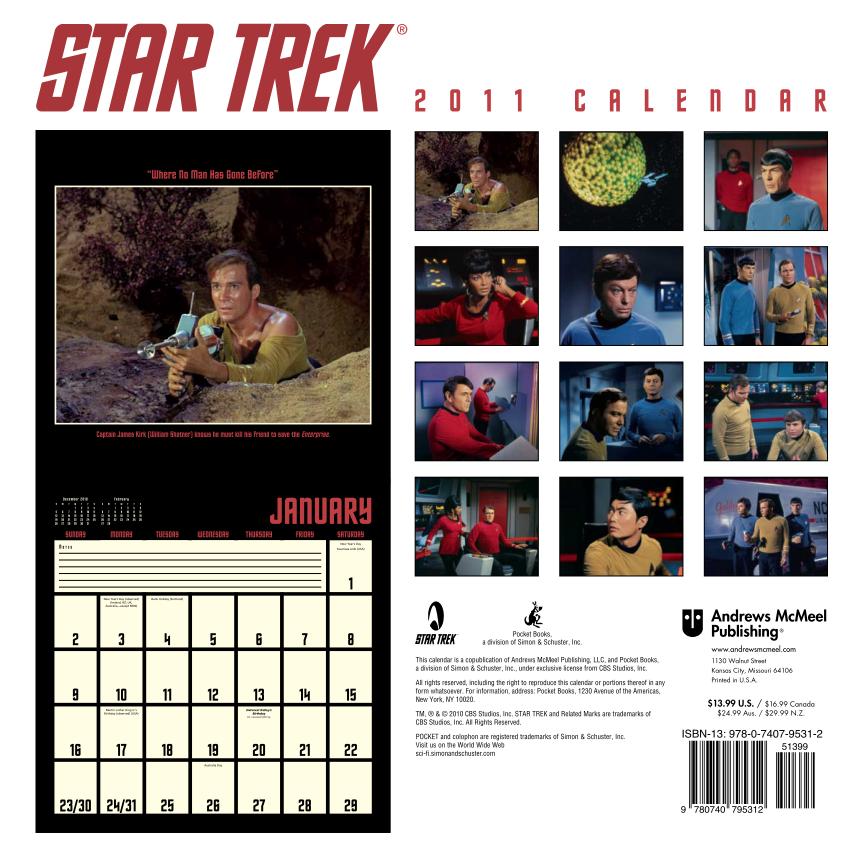
wow, TOS Trek Calendar 2011 has some great image captures!


wow, the TOS Trek Calendar 2011 has some great image captures!

Man, these image captures put most other memorbelia to shame. Specifically, ST:CCG cards come to mind.

The characters are at their best. I just love Bones' emotional face in one, and Scotty's determined and grim countenane in another.

I saw the real thing in the mall recently, and thought I'd post. I think the file is large enough for you to zoom in.

http://img.trekmovie.com/images/merchandise/STOS_fix_26.jpg
also
http://trekmovie.com/2010/06/03/exclusive-first-look-at-star-trek-2011-wall-calendar/

Saturday, November 27, 2010

Catan commentege

Lest I forget...

Everytime I play Catan (or Endeavor, or a few other games) I forget everything I learned last time I played, especially from the mistakes I made.

Well, I've decided to make a concerted effort to provide myself with a log of my gaming mistakes so I can learn from them.

In my recent game of Catan (a week ago by now; I've had trouble getting Internet time), I made my biggest mistake in allowing my opponents to cirsumvent my, by choosing too early to focus on upgrading into what I call castles. Roads before castles, moron! *Hits head* Second, I always seem to forget about my 4:1 trade with the bank. Its a bad option, but at least it's an option, that is if I remember about it. Third, although I don't think it was a crippling choice, placing my starting settlements distant from the key resources of lumber and brink was an oversight. I could have done trading for the early on, but going back to my other mistakes I built castles before roads, which allowed other players time to cut me off.

It was actually a very close game, and a good time, but I would have leaped into the lead if I had not made these oversights. And I don't like making mistakes, win or lose.

In short:
1) Roads before castles!
2) Brick and wood!
3) Remember the 4:1 option!

Quick update on my STCCG so-called Transwarp game.
Well, I have been making semi-frequent "tweaks" for quite a while now, and I need to post the newest deck list. I just added a Klingon with both SECURITY and Honor, both very Klingon traits. As a compromise to TrekSense, I removed the two Kazon-related dilemmas I had had, and that gave me the wonderful opportunity for Conundrum and Temporal Loop, both improving the game significantly I think. Players want an opportunity to battle, it seems, and temporal quicks are an essential part of the Trek experience.
Not that that will make much sense to people other than I and a few others like me ... haha

While I am blogging about gaming, I thought I'd comment on something I thought of more overtly recently than before. I would consider Catan, Citadels, and Carcassone to together be a milestone for the modern gamer. Once aquainted with these three, they have acheived what I consider a important familiarity with the gaming culture. To be frank, I am basing this on my own experience, my own entry into the gaming culture I didn't realize existed. And in large part I can be forgiven, because as I've heard tabletop board gaming as it now stands is a fairly recent thing, ushered in by Catan itself. At least for the American crowd. There have been "gaming culture" elements for a very long time, but the Catan-generation is something distinct.
Oh, and I am still reading "Intimate Lies"

Thursday, September 23, 2010

what have you read by Gene Roddenberry?

The guy didn't write all that much for print (or that was published), from what I can tell.

But I am really enjoying at the moment the novelization of Star Trek: The Motion Picture, purportedly by Gene Roddenberry.

http://books.google.com/books?id=2hW2cXOQTX8C&dq=Gene+Roddenberry+author&printsec=frontcover&source=in&hl=en&ei=jn6bTIi7LYX7lweq6unACg&sa=X&oi=book_result&ct=result&resnum=11&ved=0CEYQ6AEwCg#v=onepage&q=Gene%20Roddenberry%20author&f=false

I hate to question the intellectual property of so great a man (in my worldview), but I have become fairly skeptical of "ghost writers"
http://www.robertwestbrook.com/publishd.html##Anchor-conf

I need to do some research into the matter, as I am doing while I am blogging today, but whatever the matter, the matter stands that Gene Roddenberry had quite a hand in this book and film and I can feel fairly confident it is truthful to how Roddenberry viewed things.

This novelization is a few decades old, and as such doesn't "jive" well with the current Trek universe, the one I've come to know. Such disparity strikes me as jarringly as if the author wrote in different laws of physics than I know are accepted.

Actually, it's a bit refreshing. But, moreover, I have been made to see, thru this book and others, especialls Echos and Refractions, that Captain Kirk as a character has been handled quite inconsistently. Remember Kirk's son, David? I (like many fans I imagine) had let that memory slip to the back of my mind, and didn't consider Kirk's lingering pain over the loss. Or was there lingering pain? It wasn't discussed. And the novelization talks about Kirk as a lover of books, a visitor of historical sites, someone who enjoys research in a museum for pleasure. That's not the Kirk that's been shown to me, that I can recall. I mean, there are glimpses and suggestions, but few things that bring that to the fore, except that Kirk always seemed quite well-read and wise as far as strategic decisions go.

Well, then again, this is all all all fiction and entertainment and storytelling by many different people. So, it hardly matters to much, except insofar as my own entertainment goes. It DOES matter to me, but not in a universal way that really matters, if that makes any sense.